Handwritten cover letter: when it helps, what fits on a page, how to produce one
A handwritten cover letter is asked for by some employers in some countries, and chosen by some applicants because almost nobody else sends one. Either way the practical questions are the same: what goes in it, how long it can be before it stops fitting a page, and how to get it onto paper looking like you. This guide answers them with measured numbers.
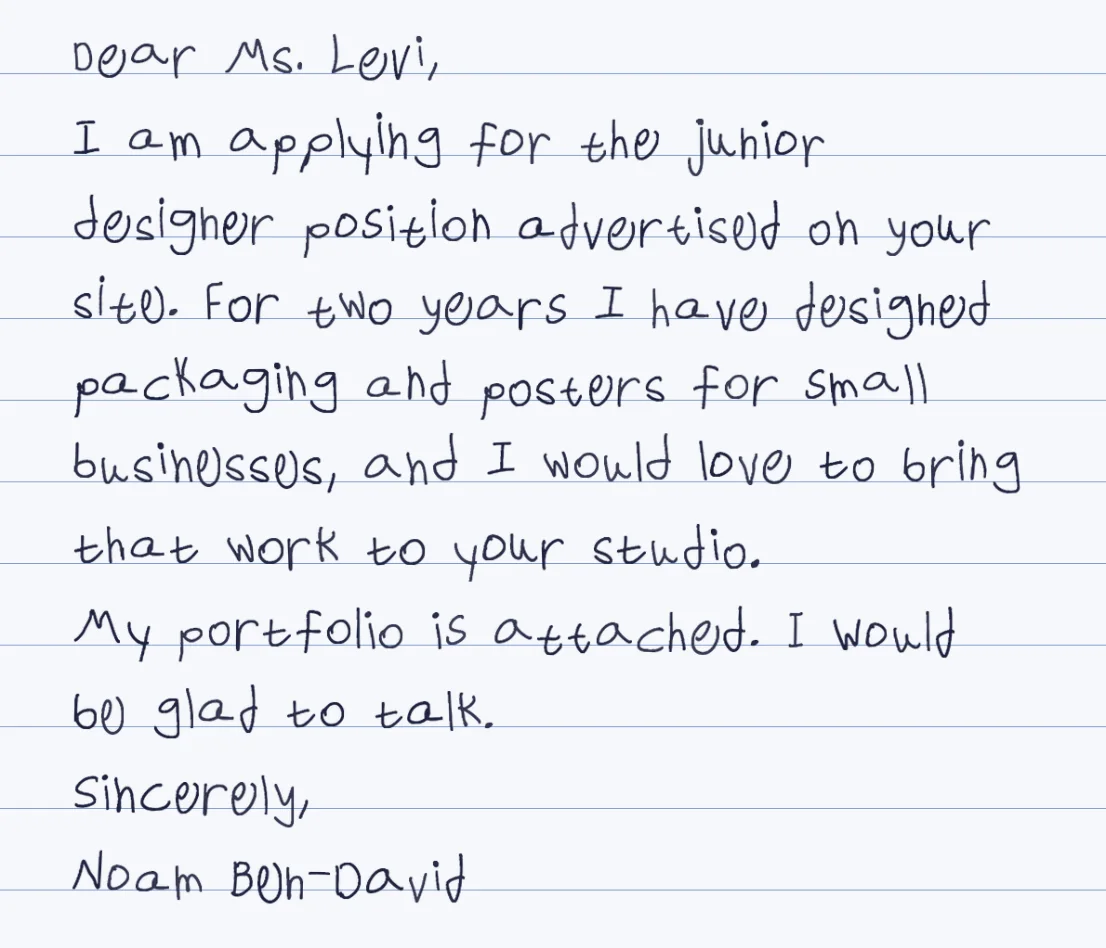
One page is the goal
About 100 words fill a page at the default size. At size 0.6 on blank paper about 250 fit.
A format that works
Greeting, the job you want, why you fit in two short paragraphs, a closing and your name.
Mind the characters
An email address with @ and names with accents cannot be drawn: put them in your CV or add them by pen.
Applicant systems read text
A handwritten PDF is an image with no text layer, so a typed copy is needed wherever software reads it first.
How many words fit on one page (sample hand, measured)
| Size setting | Blank paper | Lined paper |
|---|---|---|
| 1.0 (default) | about 100 words | about 95 words |
| 0.9 | about 125 words | about 105 words |
| 0.8 | about 150 words | about 115 words |
| 0.7 | about 185 words | about 125 words |
| 0.6 | about 250 words | about 140 words |
How it works
- Write the letter in 150 to 250 words, each part (greeting, paragraphs, closing, name) on its own line
- Paste it into Penmark, choose blank paper, and pick the size from the table so it ends on one page
- Check the preview for names and any character that was left blank, and fix the wording
- Download the PDF and print at 100 percent on good paper, or attach it where a person will read it
Try it free, a ready-made hand and a first page in seconds
When a handwritten cover letter is worth it
Some employers ask for one, and in some countries it is still ordinary; France is the best-known case. Elsewhere it is a choice, and it tends to land best with small employers, creative studios, hospitality and any role where care for detail is the job. For a large company that screens applications by software, a typed letter is what the system expects. If an employer asks for a sample of your handwriting in particular, send exactly that.
Handwritten does not mean longer. The strongest letters are short, specific to the job and easy to read, and handwriting makes length visible: two dense pages look like a lot.
A format that fits one page
Aim for 150 to 250 words. Open with the job you are applying for and where you saw it. Give one short paragraph on what you have done that matches the job, with a number or a detail, and one on why this employer. Close with a plain next step and your name. Type each of those on its own line: the engine writes lines as you give them, and in our test blank lines added no space and leading spaces were trimmed, so the layout of a letter comes from its line breaks.
Fitting the page: the measured numbers
We found the most words that stay on one page for each size setting, using the sample hand, and the table above is the result. Blank paper packs the lines as tightly as the size allows, so a 250-word letter fits at size 0.6. Lined paper has its ruling fixed, which holds the line height up and makes the size setting matter much less: even at 0.6 only about 140 words fit. If you want ruled paper, either keep the letter short or choose blank paper in the tool and print it onto ruled stationery.
A hand with larger or smaller letters than the sample moves the numbers a little. Render a draft, look at where it ends, and adjust the size in steps of 0.1 until the last line sits comfortably on the page. Size 0.6 to 0.7 reads like small neat handwriting; below that is worth printing as a test first.
The characters that cannot be drawn
Only the 155 characters of the template are written. For a cover letter that rules out an email address, which has an @, a company name with an &, and any name with an accent, such as José or Zoë. Each is left blank, and the page lists what it skipped. The practical fix is to leave contact details to the CV or write them by pen on the printed letter, and to spell and as a word. Digits, hyphens, brackets, plus signs and slashes are fine, so a phone number and a date come out as typed.
Printing and sending it
Print at 100 percent on good paper, and sign by hand if you like. If you are emailing it, remember that the PDF is one image per page, about 0.7 MB each, with no text layer: a person can read it, an applicant tracking system cannot. Where the application goes through software first, upload your typed letter there and send the handwritten one by post or as a second attachment. The handwritten letter generator guide covers the general letter, and the handwritten PDF guide explains what the file contains.
Questions & answers
Should a cover letter be handwritten?
Only if the employer asks, or if you are applying somewhere a personal touch counts. Otherwise a typed letter is the default, and software that screens applications reads text, not handwriting.
How long should a handwritten cover letter be?
About 150 to 250 words, one page. At the default size about 100 words fill a page, so size 0.6 to 0.8 on blank paper brings 150 to 250 words onto one page.
Can I print a handwritten cover letter in my own handwriting?
Yes. Fill the template once (about 10-20 minutes in total), paste your typed letter, and download a PDF in your own letters. A ready-made hand works immediately if you only want to see the result.
Why is the email address in my letter blank?
The @ sign is outside the 155 characters of the template, so it is left blank, as are & and # and accented letters. Put contact details in your CV or add them by pen.
Can an applicant tracking system read it?
No. The PDF is one image per page with no text layer. Upload a typed copy wherever software reads the application first.
What paper should I choose?
Blank, if you want to fit 150 to 250 words on a page. Lined paper holds only about 95 to 140 words however small the size.
Try it free, a ready-made hand and a first page in seconds
Penmark in numbers
- Price
- Free, no account
- Characters captured
- 155 in one template: Hebrew with final letters, English, digits, punctuation, math symbols and Greek
- Time to set up
- About 10-20 minutes in total, once. Or skip it: 91 ready-made hands work immediately
- Variations per character
- Three, from the three times you write each character
- Languages
- Hebrew and English in one sentence, plus math. No niqqud, Hindi, Arabic or Cyrillic
- Output
- PDF, Word (docx) or PNG on lined, grid, dotted or blank paper
- Privacy
- Uploads deleted within about 24 hours; your library stays in your browser
- Not included
- No installable font file, no tables or graphs, no OCR of scans