AI handwriting generator: what it does, and what Penmark does instead
Search for an AI handwriting generator and you meet at least three different things under one name. Knowing which is which saves you an afternoon, and it explains why some results look like you and others look like a stock font. Here they are, and where Penmark sits among them.
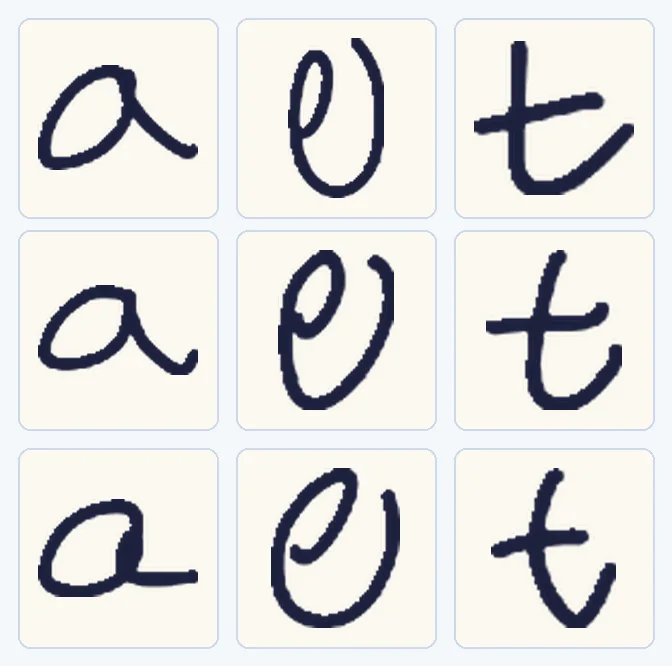
Synthesis models invent strokes
A neural model can generate pen strokes in a learned style. It is a guess at a style, not your letters.
Many AI generators are fonts
A preset style plus some random jitter, sold as AI. Everyone who picks the style gets the same letters.
Penmark captures, it does not invent
Your own letters from one template, three variations of each, written out as pages.
Free, no account
A ready-made hand lets you see the result before you capture anything.
Three things sold as AI handwriting
| What it is | Where the letters come from | Honest limit |
|---|---|---|
| A stroke-synthesis model | Generated by the model in a learned style | A style, not your letters. From one short sample it has to invent every letter you did not write |
| A preset-style tool called AI | A stock font with randomised size and slant | The same letters as everyone who picks the style |
| An assistant that writes your text | Not applicable: it writes words, not letters | You still need something to render the words in handwriting |
| Penmark | Your own letters, captured from one template | Needs the filled template; it does not invent or extend your hand |
How it works
- Open Penmark and press try-now to see a page in a ready-made hand
- To make it yours, print the template and fill it with a dark pen, three times for each character
- Photograph each page flat with all four corner squares in the frame, and upload
- Paste or upload your text and download pages in your own letters
Try it free, a ready-made hand and a first page in seconds
The three things the name covers
The research kind of AI handwriting generation trains a neural network on pen strokes and asks it to produce new strokes in a learned style. It is a real technique and it can look striking, but what comes out is a model's guess at a hand, and it is mostly found in demos and papers rather than as a tool you can use for a letter or an assignment.
The common kind is simpler. Many sites that say AI take a stock handwriting font, add random variation to size and slant, and call the result a generator. It is fast and free, and everyone who picks that style gets the same letters, so it never looks like you. The third meaning has nothing to do with letters: people use an AI assistant to write the text, and then need a way to put that text on a handwritten page.
Why one sample cannot give you every letter
A frequent request is to upload a sample of your writing and let the AI do the rest. The difficulty is arithmetic. A sentence of handwriting contains a few dozen distinct characters, in one version each. To write anything else, a generator must make up every letter you did not write, every digit, and every capital you did not use, and make up the second and third version of the ones you did. What you get back is a guess at your style, applied to letters you never showed it.
Capturing is the opposite approach. The template asks for every one of 155 characters, three times each, so nothing has to be invented: the engine has your own q, your own 7, your own question mark, and three versions of each to alternate. It is a slower start, about 10-20 minutes in total, once, and it is the reason the pages look like you wrote them.
What Penmark does, and does not do
Penmark re-renders. Paste text, and each character is drawn from your captured tiles, alternating variations and adding a small change of size and slope, with Hebrew and English in one sentence and math laid out properly. It is not AI that learns your style and extends it: it will not write a letter you did not capture. A character missing from the template is borrowed from a ready-made hand and flagged, and the page lists any characters it could not draw.
That also draws the line on text. Penmark does not compose your words. If you use an assistant for the writing, the homework page has a wizard that prepares the request in the format the engine reads, and you paste the answer back. The rendering is the same either way.
Which to choose
If you want something that looks like you, capture your own letters. If any neat handwriting will do and you want it in under a minute, a preset tool is faster, and the TextToHandwriting.com comparison is a fair side-by-side. If what you have seen sold as AI handwriting was really a font, the guide to why handwriting fonts look fake explains the difference variation makes.
Questions & answers
Is Penmark an AI handwriting generator?
No, not in the sense of a model that invents strokes. It captures your own letters from one template and re-renders them, three variations of each of 155 characters. It does not generate letters you did not write.
Can an AI generate my handwriting from a sample?
A generator working from one sample has to invent every letter, digit and capital that the sample does not contain, so the result is a guess at your style. A template that captures every character avoids the guessing.
What is the difference from a preset handwriting generator?
A preset tool uses a stock font style, often with random jitter, so everyone who picks it gets the same letters. Penmark uses your own captured letters, or one of 91 ready-made hands.
Does Penmark write my text with AI?
No. It renders the text you provide. If you use an assistant to draft the words, you paste its answer in, and the homework page has a wizard that prepares the request in the format the engine reads.
Is it free?
Yes, with no account and no per-page charge.
How long does capturing my own letters take?
About 10-20 minutes in total, once. After that a page takes seconds. A ready-made hand needs no setup.
Try it free, a ready-made hand and a first page in seconds
Penmark in numbers
- Price
- Free, no account
- Characters captured
- 155 in one template: Hebrew with final letters, English, digits, punctuation, math symbols and Greek
- Time to set up
- About 10-20 minutes in total, once. Or skip it: 91 ready-made hands work immediately
- Variations per character
- Three, from the three times you write each character
- Languages
- Hebrew and English in one sentence, plus math. No niqqud, Hindi, Arabic or Cyrillic
- Output
- PDF, Word (docx) or PNG on lined, grid, dotted or blank paper
- Privacy
- Uploads deleted within about 24 hours; your library stays in your browser
- Not included
- No installable font file, no tables or graphs, no OCR of scans