Handwritten recipe card: type it, print it in handwriting, even grandma's
A recipe in someone's own handwriting is a keepsake, and a typed one is a recipe. The gap between them is usually a free evening nobody has. Penmark closes it two ways: type the recipe and get a card in a ready-made hand, or capture a parent's or grandparent's handwriting once and write every recipe in it, including the ones they never got around to writing down.
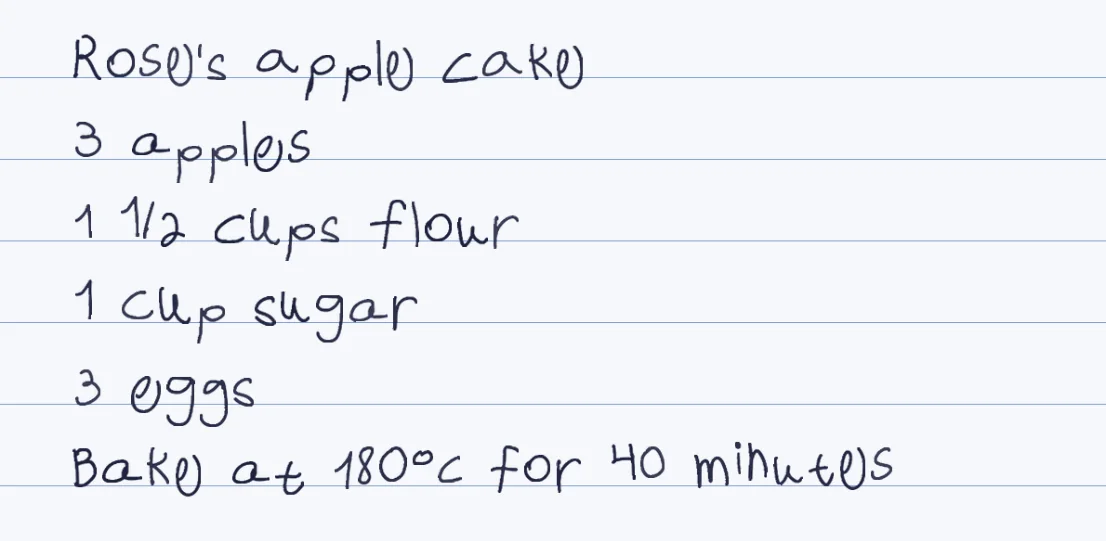
One ingredient per line
Quantity first, then the item. The engine writes the lines as typed.
Type fractions as 1/2
The single-character fraction signs are not in the template; a plain slash renders cleanly.
Grandma's hand, every recipe
Capture a relative's handwriting once and write any recipe in it, new or old.
Print on card stock
A page prints at 100 percent; scale it down in the print dialog for a smaller card.
How it works
- Type the title, then one ingredient per line, then the method in short steps
- Open Penmark and pick a ready-made hand, or load the captured handwriting of the person whose recipe it is
- Choose lined or blank paper, and set the size so the recipe fills the card
- Download the PDF or PNG and print on card stock, scaling it down for a smaller card
Try it free, a ready-made hand and a first page in seconds
A recipe that renders well
Put the title on its own line, then each ingredient on a line of its own with the quantity first, then the method as short numbered steps. The engine writes plain lines, so the structure is in the typing: blank lines did not add space in our test and leading spaces are trimmed, which means a list reads best when every ingredient is its own line.
Fractions are the first surprise. The one-character signs such as the half and the quarter are not among the 155 characters the template holds, so type 1/2 and 3/4 with a slash, which renders as written, the way a person scribbles it. A degree sign is in the set, so 180°C comes out as typed; write tbsp and tsp for spoons, and x for multiplication. Two spellings need care: an accented letter is left blank, so write jalapeno, creme fraiche and cafe without the accent.
Grandma's handwriting, every recipe
The best use of a recipe card is the one that cannot be bought: a recipe in the actual handwriting of the person who made it. Ask them to fill the template once with a dark pen, about 10-20 minutes in total, photograph the pages flat, and upload them. Penmark keeps three variations of each of their letters, digits and symbols, and from then on you can write any recipe in their hand, including ones they only ever told you aloud.
Say so, on the card or when you give it: it is a rendering of their letters, written by you after the fact. People who receive one tend to treasure it precisely because it looks like them, and being clear about how it was made keeps it a gift rather than a trick. Keep the original filled sheets, too: they are the real thing. The keepsake page goes further into preserving a handwriting.
Size, paper and printing
The output is a full page, 216 by 283 mm. A short recipe fills only the top of it, so there are two sensible ways to get a card. Print the page on card stock and cut it down, leaving the rest as a second card for the next recipe if you render them one under another. Or use your printer's scaling, to about half, which gives a card-sized recipe with the writing at a readable size. Lined paper in the tool gives the notebook-card look; blank is better if you will print onto ready-made lined cards.
The ink colour can be changed in the preview, and a dark blue reads like a ballpoint on card. Print one card first and check the size before you print the set.
A set of recipes, or a recipe book
Recipes pasted one after another come out as one continuous document, a page after page of lines. For a printed book, render each recipe as its own document so each starts on a fresh page, and then gather the PDFs. For a box of cards, the same, then print scaled. It takes seconds per recipe once the hand is loaded, which is what makes writing out thirty family recipes realistic.
Questions & answers
How do I type fractions in a handwritten recipe?
Write them with a slash, such as 1/2 or 3/4. The single-character fraction signs are not among the 155 characters the template holds, but the slash is, and it renders as a scribbled fraction.
Can I make a recipe card in my grandmother's handwriting?
Yes. Have her fill the template once with a dark pen (about 10-20 minutes in total), photograph the pages flat and upload them. Then you can write any recipe in her handwriting.
Why are letters like the n in jalapeno missing?
Accented letters are outside the template's 155 characters and are left blank. Write ingredient names without the accent.
Does the degree sign work?
Yes. 180°C is written as typed. Spoons and cups render as words such as tbsp, tsp and cup.
What size is the card?
The output is a full 216 by 283 mm page. Print it on card stock and cut it, or scale it down to about half in the print dialog for a card-sized recipe.
Can I do a Hebrew recipe?
Yes. Hebrew renders right to left with final letters, and measures and numbers sit in place. The Hebrew version of this page shows one.
Try it free, a ready-made hand and a first page in seconds
Penmark in numbers
- Price
- Free, no account
- Characters captured
- 155 in one template: Hebrew with final letters, English, digits, punctuation, math symbols and Greek
- Time to set up
- About 10-20 minutes in total, once. Or skip it: 91 ready-made hands work immediately
- Variations per character
- Three, from the three times you write each character
- Languages
- Hebrew and English in one sentence, plus math. No niqqud, Hindi, Arabic or Cyrillic
- Output
- PDF, Word (docx) or PNG on lined, grid, dotted or blank paper
- Privacy
- Uploads deleted within about 24 hours; your library stays in your browser
- Not included
- No installable font file, no tables or graphs, no OCR of scans